 English
  German
  Russian
  Japanese
  Korean
  Spanish
  French
  Italian
  Portuguese
 Quick answer:
A CNC milling machine is a computer-controlled system that removes material from a workpiece using rotating cutting tools. Unlike manual milling, it follows programmed tool paths to produce parts with tight tolerance requirements and repeatable geometry across full batches. The machine reads CAM-generated files and drives one or more axes to position each cutter. This makes it suitable for everything from flat 2D profiles to complex 5-axis aerospace CNC component manufacturing. The core value is consistency: the same part can be reproduced thousands of times with minimal dimensional drift, which is why CNC machining dominates modern production and prototyping workflows.
If you are evaluating a machine purchase, outsourcing a production run, or trying to understand what happens between a CAD model and a finished part, the terminology around CNC milling can feel dense. This breakdown focuses on the points that actually affect your project timeline, part quality, and per-unit cost.
What Exactly Is a CNC Milling Machine?
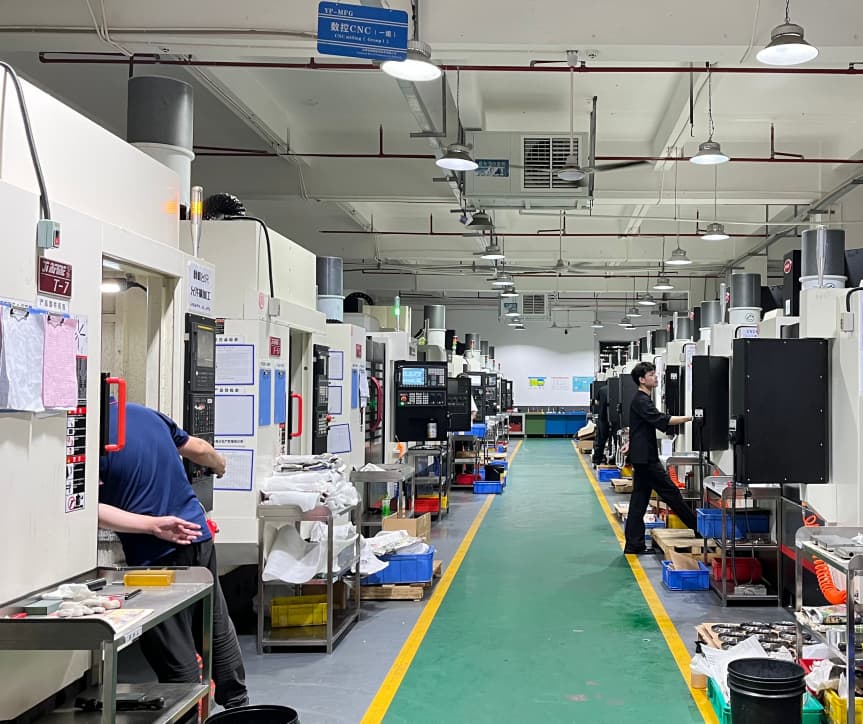
At its core, a CNC mill is a subtractive manufacturing system. A workpiece is clamped or vacuum-held on a table while one or more rotating end mills, face mills, or drills remove stock to form the desired shape. The process is fully material-removal; nothing is added.
The “CNC” layer means every axis movement is driven by stepper or servo motors following a numerical program. The operator does not turn hand wheels. Spindle speed, feed rate, and tool-change sequence all come from a post-processed tool-path file loaded into the controller.
This computerized control is what separates CNC from a manual mill. Repetition accuracy typically holds within a few microns across a batch, a level of consistency that hand-wheeled machines cannot guarantee. That precision is the reason most production and CNC machining environments have moved away from manual equipment.
Key Components and How They Interact
Five subsystems do most of the work:
Machine frame and bed – heavy castings or welded steel minimize vibration under cutting loads.

Spindle and drive – governs maximum RPM, available torque, and tool compatibility.
Axis carriages and ball screws – determine travel range, positioning accuracy, and achievable feed rates.
Tool magazine / automatic tool changer – enables unattended multi-operation programs.
Control system and CAM software – interprets the tool path and manages machine interlocks.
Understanding how these subsystems interact helps you read a spec sheet with confidence. A faster spindle is useless if the machine rigidity cannot absorb the resulting cutting forces without inducing chatter. Likewise, adding a 5-axis head only pays off when your part geometry actually demands simultaneous orientation changes.
YPMFG can walk a buyer through a spec sheet and flag where a machine’s envelope may not match a part’s fixturing or clearance needs.
Types of CNC Milling Machines
Mill configurations split along two axes: the number of simultaneous axes and the table or head orientation.
The right configuration depends on part geometry, batch size, and whether 3-axis vs 5-axis milling saves setup time or simply adds cost. For most prismatic components, a 3-axis vertical mill with a standard ATC covers the need without overpaying for unused axes.

How to Choose or Evaluate a CNC Mill
Before committing to a purchase or releasing a part to a vendor, run through a short checklist:
Confirm tool path programming compatibility: does the controller accept your CAM output (Fanuc, Siemens, Heidenhain, or proprietary)?
Verify the working envelope and maximum part size with fixturing included.
Match spindle power and RPM range to your material selection; hardened steel demands lower speeds and higher torque.
Request repeatability data: a laser-interferometer report or ball-bar trace is a standard benchmark.
Clarify whether post-machining inspection (CMM, in-situ probing, or optical scan) is part of the cell or an external step.
If you are outsourcing rather than buying, the checklist shifts. You send your drawings and ask the vendor which configuration they would assign, how they verify dimensional stability, and what quality documentation they deliver with each lot. YPMFG supports this exact workflow: send your part geometry and material spec, and the team returns a recommended setup, cycle-time estimate, and a first-article inspection plan before any cutting begins.
Common Questions About CNC Milling
Can a CNC mill produce parts in any material?
Most industrial mills handle aluminum, mild steel, stainless, titanium, and common engineering plastics. Exotic superalloys or hardened tool steel require higher spindle torque and a coolant system rated for the thermal load. Confirm the vendor’s supported material list before releasing a job.
What tolerance can a CNC mill realistically hold?
On a well-calibrated 3-axis vertical, ±0.01 mm is routine across a batch. Fine-feature work or 5-axis simultaneous linking can reach ±0.005 mm, but tool deflection and surface finish become the limiting factors. Specify your critical dimensions and ask which tool strategy the machinist would use.
How is a CNC mill different from a CNC router?
A router is a lighter, wood-and-plastics-oriented machine with a smaller spindle and lower frame rigidity. A mill is built for metal: heavier bed, higher-torque spindle, closed-loop servo drives, and chip-management features. The two are not interchangeable for metal CNC machining tasks.
Do I actually need a 5-axis machine for my part?
Usually not. Steep undercuts, complex free-form surfaces, or simultaneous multi-axis orientation are where 5-axis earns its cost. For flat or prismatic work, a 3-axis mill with two or three setups is faster and cheaper. Run a simple fixturing study before paying for extra axes.
## Making a Smarter Decision on Your Next Machining Project
The core value of understanding a CNC milling machine is simple: you match the right configuration, material path, and quality gate to your part instead of guessing. That reduces rework, protects cycle-time budgets, and keeps first-article surprises to a minimum.
If you have a part in hand—drawings, a 3D model, or even a rough sketch—send it to YPMFG for a no-obligation engineering review. The team will recommend a machine configuration, estimate cycle time, and outline a post-machining inspection plan so you know exactly what the finished part will look like before a single chip is cut.