Russian
 English
 German
 Japanese
 Korean
 Spanish
 French
 Italian
 Portuguese

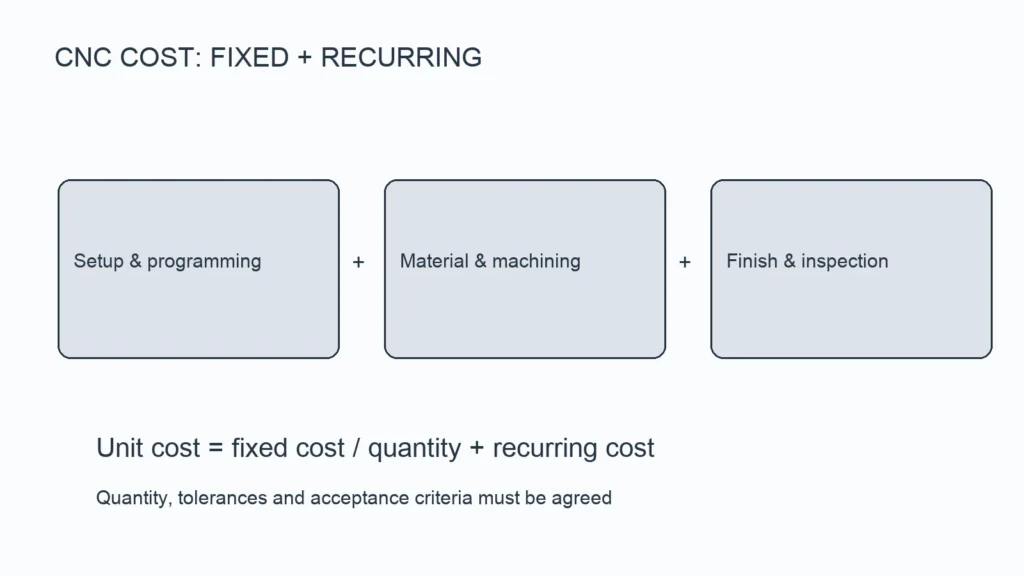
A CNC machine quote is a formal pricing document issued by a machining shop based on your part drawings, material selection, tolerances, and production volume. It typically breaks down unit cost, setup fees,lead time, and any applicable tooling or prototyping charges. The accuracy of your quote depends almost entirely on the clarity of the specifications you provide. Incomplete drawings or vague material calls are the most common reason quotes come back with caveats or require follow-up calls.
Before you send out a request, the real question is whether you have the right information packaged so a machinist can price your job without guessing. Missing a critical tolerance call or an unlisted surface finish can add 10–20% to the final number once it gets clarified.
What a CNC Machine Quote Typically Includes
A well-structured CNC machine quote from a professional shop will list the following line items:
Unit price (per part, per lot)
Setup and tooling fees (if applicable)
Material grade and quantity
Tolerance class and surface finish specifications
Post-machining operations (deburring, heat treatment, plating)
Lead time in working days
Payment terms and validity window of the quote
Each item should reference the specific drawing revision. If a shop gives you a single lump-sum number without this breakdown, ask for the itemized version. It protects you when scope changes later.
What You Need Before Requesting a Quote
Sending the right package up front saves a round of back-and-forth and often gets you a more competitive number. Here is the checklist most machinists expect:
2D drawings or a 3D CAD file (STEP, IGES, or DXF preferred)
Material specification (alloy grade, not just “steel” or “aluminum”)
Critical tolerances called out on the drawing, not assumed
Surface finish requirements (Ra values, plating type)
Quantity per order and expected annual volume
Any functional test or inspection standards (e.g., GD&T, ISO 2768)
If your drawing set is ambiguous, a machinist will price in a risk buffer. That buffer shows up as a higher unit price with no visible justification. YPMFG engineering team can review your files and flag ambiguity before it inflates your CNC machine quote.

Factors That Affect Your CNC Machine Quote
The variables that move the number are consistent across shops, but their impact size varies by part geometry and material. Use this table to estimate where your cost is coming from:
Read the table top to bottom. In most projects, material choice and the tightest single tolerance drive the largest share of cost. You can often recover margin by relaxing a tolerance that does not affect assembly fit.
Selection criteria like “does this tolerance actually matter for function?” should drive your drawing notes before you send them to a supplier. YPMFG can run a quick техническая оценка on your file and recommend tolerance classes that match your сценарий применения without over-machining.
## Common Questions Before Requesting a CNC Machine Quote
How long does a quote usually take?
Most shops respond within 1–3 business days for straightforward parts. Complex multi-axis or tight-tolerance work may take up to 5 days. If you have a hard deadline, state it in your initial email.
Do I need to send physical samples?
Not for most CNC jobs. A verified 3D CAD file and drawing set are sufficient. Samples are typically requested only when tooling or fixture design is involved.
What if my drawings are in PDF or paper format?
You can send them, but expect a slower turnaround. Digital CAD files (STEP, IGES) reduce interpretation risk and usually speed up quoting by one to two days.
Can I get a quote for a small batch, say 5–20 pieces?
Yes. Small batches carry a higher per-unit price because setup costs are spread over fewer parts. Many shops offer a prototype tier at a different rate than production volumes.
How much will my quote change if I switch materials?
Expect 15–40% movement between common alloys (e.g., 6061-T6 to 7075-T6, or 304 to 316L). The exact delta depends on machining time, tool wear rate, and finishing steps.
Is the quote valid for my entire order?
Quotes carry an expiry window, often 30 days. Material prices and currency fluctuations can shift the number after that window. Confirm validity before you issue a PO.
Making a Better Decision on Your Next Quote
The single biggest cost risk in a CNC machine quote is sending vague or incomplete specs and then absorbing the markup for ambiguity. A clean drawing set, a realistic tolerance call-out, and a stated quantity give any shop a fair basis to price your work.
You can send your current files to YPMFG for a no-obligation review. The team will check your drawings for missing GD&T calls, flag any tolerance classes that may be over-specified, and return a preliminary cost range so you know where you stand before committing to a production run.