German
 English
 Russian
 Japanese
 Korean
 Spanish
 French
 Italian
 Portuguese

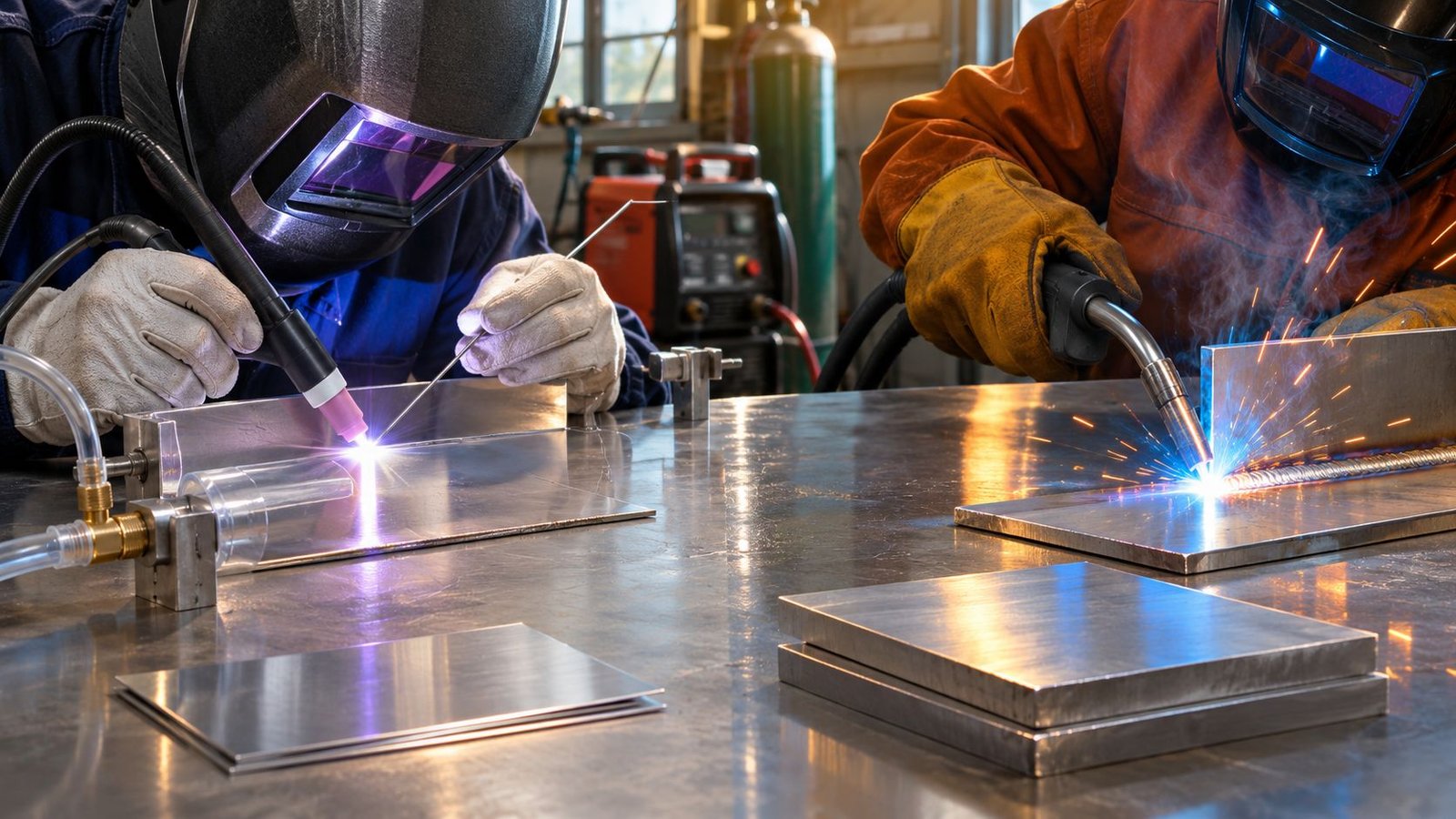
TIG suits thin sheet under 1 mm where heat control is the bottleneck. MIG handles gauges above 1.5 mm at production speed. The 1 to 1.5 mm crossover depends on joint design and access.
Most sheet metal buyers hit the same wall: a panel that must not warp, a deadline that will not stretch, and a seam that has to pass visual inspection. Picking the wrong method adds rework, scrap, or a failed fit-up. YPMFG has seen both choices made and unmade on the shop floor. The guide below walks through the decision without guessing.
Die wichtigsten Erkenntnisse
- Heat input: TIG concentrates energy in a small pool; sheet under 1 mm stays flat. MIG’s wider heat band pushes thin panels into distortion.
- Throughput: MIG lays roughly 2 to 3 times the weld length per hour versus TIG on the same joint, once setup is complete.
- Joint prep: TIG needs a clean fit-up under 0.5 mm gap. MIG tolerates gaps up to 2 mm with the right wire angle.
Which Method Fits Your Sheet Metal Spec?
Use this table as a first-pass filter before opening the drawing.
When your gauge lands between 1 and 1.5 mm, check the flatness spec first. If it reads under 0.5 mm per 1000 mm, lean TIG. If speed matters more and a small warp is acceptable, MIG wins.
What Makes TIG and MIG Different on Thin Stock?
The core difference is heat concentration. TIG focuses the arc into a small, stable pool. MIG pushes a continuous wire into a wider zone. On 1 mm mild steel, TIG adds roughly half the heat input of MIG at the same travel speed.
That concentration lets a TIG operator hold the pool small enough to avoid burn-through on 0.5 mm panels. MIG’s wire feed adds metal and heat together, so the pool spreads and the sheet flexes. For a panel that must stay flat within 0.5 mm over a meter, that flex becomes a rework cycle.
Practically, TIG is a heat-control tool. MIG is a metal-deposition tool. The choice is not about which is better. It is about which failure mode you can absorb: warpage or throughput lag.
Before selecting, check your flatness spec and minimum acceptable weld speed. Those two numbers decide the method before aesthetics do.
How Do You Choose by Thickness, Joint Design, and Access?

Thickness is the first filter. Under 1 mm, TIG with a tight purge shield is the standard path. From 1.5 mm up, MIG handles the joint without risking a burn-through that TIG avoids only at slower speed.
Joint design shifts the answer. A butt joint on thin sheet calls for TIG with a backing rod or argon purge. A lap joint with a 1 mm gap favors MIG, which fills the void while the wire feeds. A corner joint on 2 mm stock is a toss-up unless one face is inaccessible, in which case TIG’s smaller nozzle wins.
- Butt joint, under 1 mm: TIG with argon purge on the back side.
- Lap joint, 1 to 2 mm gap: MIG, wire at 15 to 25 degree angle.
- Corner or T-joint, 2 mm plus: Either method; check access first.
If you cannot prep the joint to a tight fit-up, MIG’s gap tolerance saves a second fabrication pass. If the part must ship without post-weld finishing, TIG’s cleaner bead means less grinding. A physical limit to note: no weld method eliminates residual stress entirely on thin sheet. Fixturing and sequencing reduce it, but the material still shrinks as it cools. Plan for a small correction in your tolerance stack.
What Cost and Speed Tradeoffs Should You Plan Around?
MIG runs 2 to 3 times faster on long, repeat joints. A 2-meter lap weld that takes a TIG operator 40 minutes drops to 15 in MIG, once the wire feeder is set. That gap scales with run length.
TIG costs more in labor hours but less in rework. On thin sheet, a MIG operator who pushes too fast warps the panel. The flattening cycle and re-weld erase the speed advantage. On thicker stock, TIG’s slower deposition means more torch time per joint and higher labor cost.
Gas and consumables also differ. TIG uses a tungsten electrode and argon, both low-volume. MIG consumes wire continuously; a full spool in one shift is normal on production. For a one-off repair,TIG’s consumable cost is negligible. For 500 identical brackets, MIG’s wire cost amortizes across the run.
Ask your fabricator for a per-joint time estimate at your target speed before signing off. A single number on a quote hides the rework risk. YPMFG flags that risk in the engineering review before a quote is issued.
Where Do Common Sheet Metal Schweißen Jobs Go Wrong?
Three failures show up on the floor repeatedly. The first is running MIG on 0.5 mm sheet without pre-clamping. The panel flexes into a wave that post-weld correction cannot fully remove.
The second is a TIG operator chasing speed by raising amperage. The pool widens, the edge burns through, and the joint needs a patch. The third is poor fit-up: a 2 mm gap fed with TIG wire too thin to bridge it, leaving a sagged seam that fails visual inspection.
Each failure is a spec mismatch, not a skill problem. The sheet thickness, gap size, and required flatness must all be written on the drawing. If any one is missing, the risk lands on the buyer, not the welder. The limit here is access: no amount of process tuning fixes a joint you cannot reach with the torch or wire.
How TIG and MIG Handle a Typical Sheet Metal Bracket: A Process Route
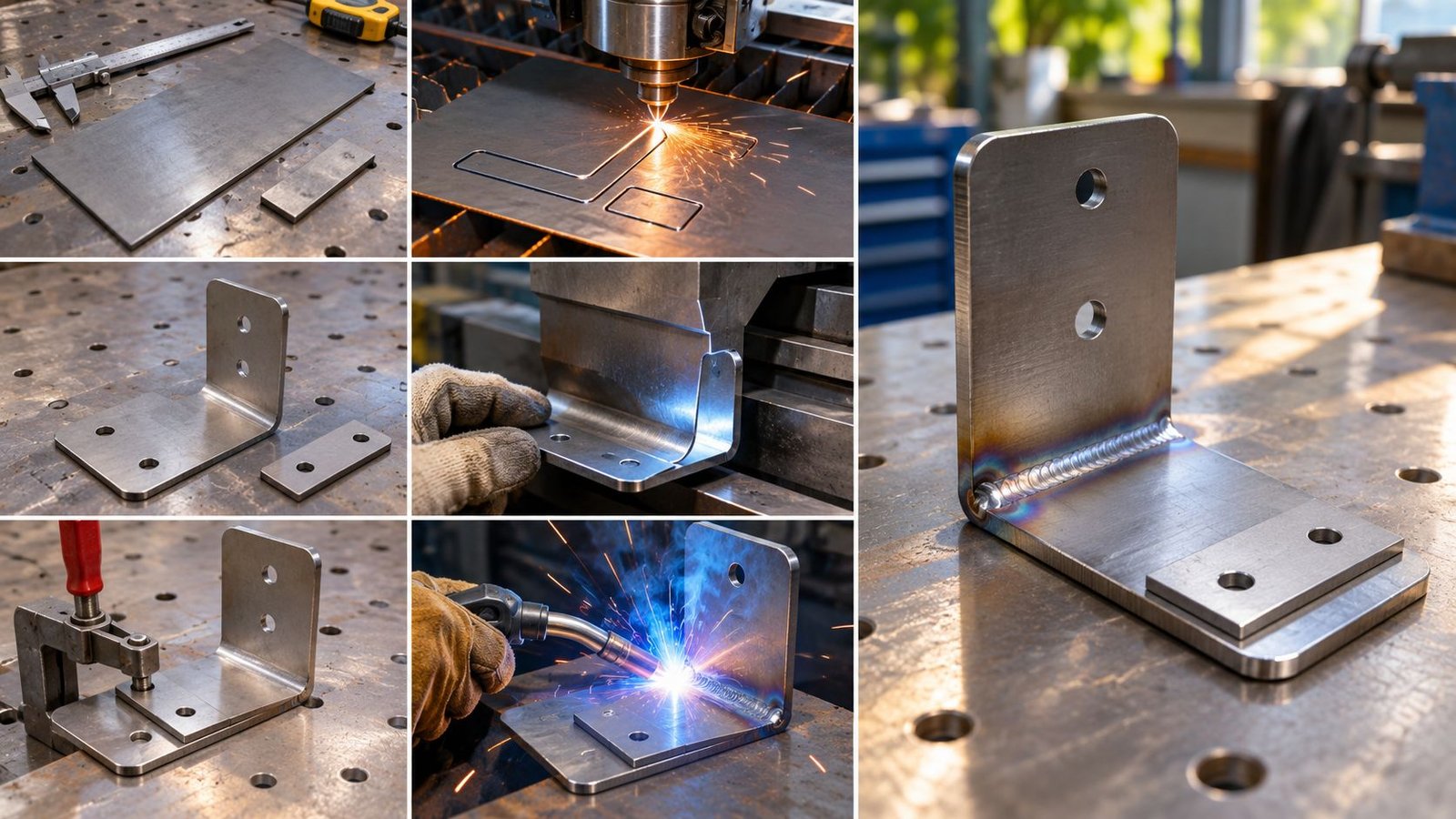
A 1.5 mm mild-steel bracket with a 90-degree corner weld and a 2 mm tab lap joint is a common fixture component. Here is the route a shop would run.
- Cut and deburr: laser or sheared to final dimension, 0.3 mm deburr on all edges.
- Clamp fixture: vise-grip and backing block to hold the 90-degree angle; gap under 0.3 mm.
- TIG the corner: 60 to 80 A, 2.4 mm argon flow on the back, steady travel speed at the joint.
- MIG the lap tab: 0.8 mm wire, 70/30 shield gas, 15-degree wire angle into the 2 mm gap.
- Inspect: visual check for porosity, then a dye-pen test on the corner if the spec calls for it.
Process Route Reference: YPMFG process library, reviewed against published tooling and welding data. Client-specific parameters withheld per NDA.
Fig 1. Crossover zone: below 1 mm favors TIG, above 1.5 mm favors MIG; between, the flatness spec decides.
Practical Questions Before Picking Your Method
Can MIG weld 0.5 mm sheet without warping? It cannot. The heat zone is too broad for that gauge. TIG with a purge shield is the workable path; MIG on 0.5 mm will almost always leave a visible wave.
Does TIG work on stainless and aluminum sheet? Yes. TIG handles 304, 316, and 6061 aluminum with the right filler and gas. MIG also runs on aluminum, but wire cost and setup time push the threshold to thicker panels.
How do I check a weld seam on thin sheet? Run a straightedge across the cooled bead. If the gap exceeds 0.5 mm over a 100 mm span, the panel has warped beyond most cosmetic specs. A dye-pen test catches subsurface cracks the eye misses.
What should I send a fabricator before requesting a quote? Send the drawing with thickness, joint type, flatness tolerance, and material grade. Without those four numbers, any quote is a guess and the rework cost is yours.
Choosing the Right Weld for Your Sheet Metal Work
The right method is not the prettier bead. It is the one that keeps your panel flat, your schedule intact, and your inspection pass rate high. If the gauge is under 1 mm and flatness matters, TIG earns its slower pace. If you need length and speed on 1.5 mm and up, MIG delivers it.
Send your drawing, material spec, and tolerance stack to YPMFG for an engineering review. You will get a method recommendation, a fixture note, and a rework-risk flag before any metal moves. That one conversation avoids a scrap batch later.