 Portuguese
  English
  German
  Russian
  Japanese
  Korean
  Spanish
  French
  Italian
 Resposta rápida:
CNC drilling delivers high-precision holes in metals, plastics, and composites using computer-controlled routers or milling centers. It is ideal for tight tolerances, repeatable production runs, and complex part geometries. Typical applications include aerospace brackets, medical implant fixtures, and automotive engine components. When selecting a CNC drilling service, verify machine capability, tooling inventory, material expertise, and quality documentation. YPMFG offers engineering evaluation, custom process planning, and sample testing to match your specification.
CNC drilling forms the backbone of modern precision manufacturing. Buyers often request quotes without knowing whether their hole patterns, depths, or surface finish requirements are realistic for high-volume production. Missing these details can delay lead times, inflate costs, or produce parts that fail functional testing. YPMFG specializes in CNC drilled components for industrial applications where dimensional stability matters. This article explains how to choose a reliable provider, what specifications to prepare, and how to avoid common machining pitfalls.
Understanding CNC Drilling Capabilities and Limits
CNC drilling differs from manual drilling because the machine controls feed rate, spindle speed, and tool path with digital precision. This consistency reduces burr formation, improves hole roundness, and maintains positional accuracy across large batches. Modern CNC centers can drill diameters from 0.1 mm to over 50 mm in a single setup. They also handle deep-hole drilling,stepped holes, and counterbores without repositioning the workpiece.
Several factors influence achievable quality. The first is machine rigidity and spindle runout. A stiff spindle minimizes vibration when drilling hardened steel or titanium. The second is tool selection and coating. Carbide drills with TiAlN coatings last longer and produce cleaner cuts in aluminum. The third is coolant strategy. Through-spindle coolant flushes chips from deep holes and prevents heat buildup. Buyers should ask the supplier for a capability sheet that lists maximum drilling depth, taper tolerance, and surface roughness values.
If your design requires micro-holes or near-net-shape drilling, confirm the vendor has specialized equipment. Standard CNC mills may not achieve the same precision as dedicated drilling centers. Requesting a prototype sample before full production reveals whether the process can meet your tolerance stack-up.
Key Specifications to Provide for a Quote
Submitting complete drawings prevents back-and-forth emails and accelerates quotation turnaround. The following parameters are essential for any CNC drilling service quote:
Drawing with GD&T, including hole callouts and positional tolerances
Material grade, temper, and condition (e.g., 6061-T6 aluminum, 316L stainless)
Required surface finish on drilled walls and entrance/exit faces
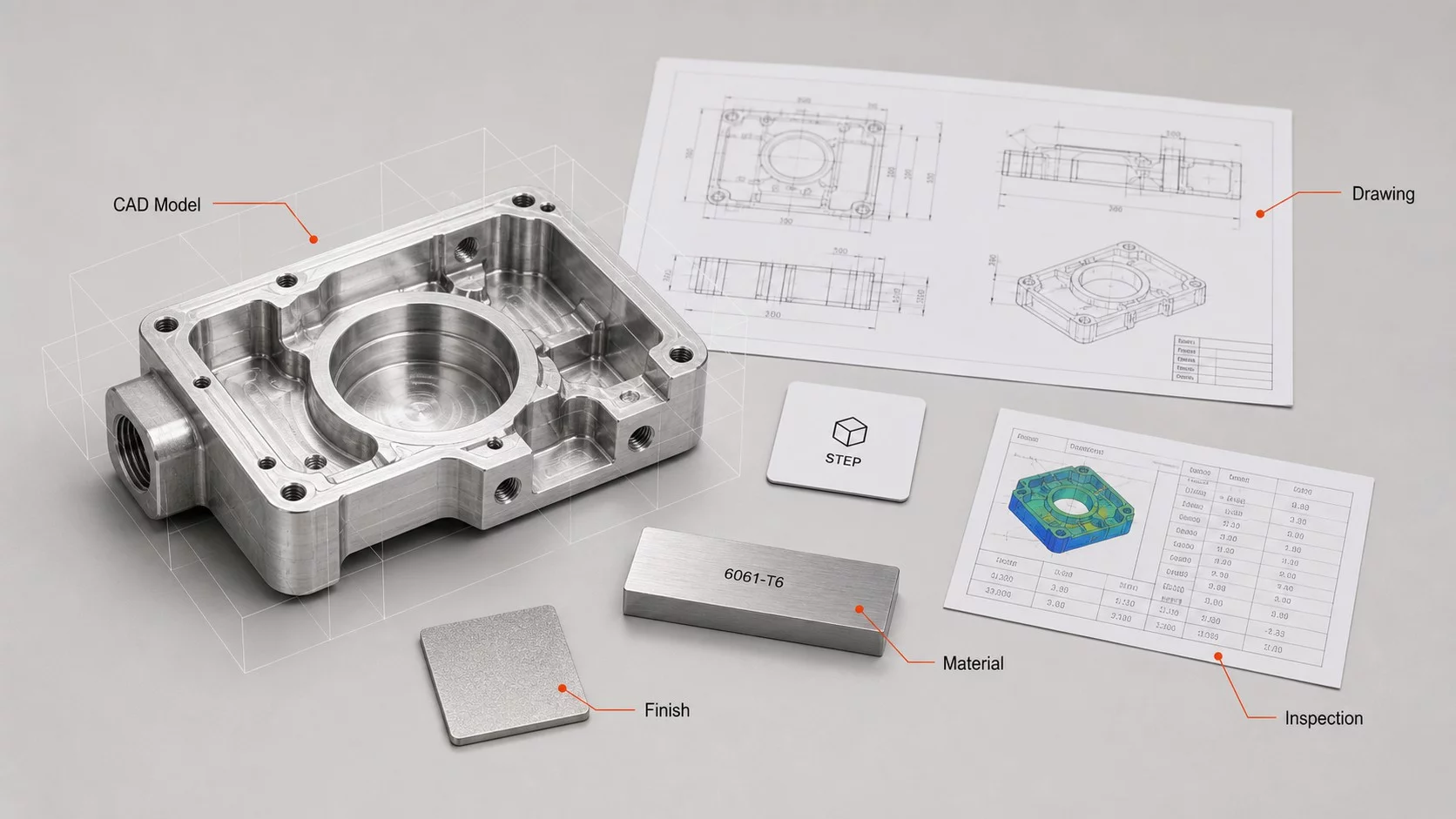
Quantity and production volume expectations
Any secondary operations like deburring, tapping, or anodizing
Omitting material specification often leads to incorrect cost estimates. Suppliers may assume a cheaper alloy and later discover the part must meet corrosion resistance standards. Similarly, vague tolerance language such as “±0.1 mm general” can cause confusion. Specify critical hole positions in a separate feature control frame. If you lack detailed drawings, many shops offer engineering review services to help define manufacturable tolerances.
Another frequent oversight is ignoring drill breakage risk. Deep holes with length-to-diameter ratios above 10:1 require peck drilling cycles. Ask the manufacturer how they prevent tool fracture and ensure chip evacuation. A robust process includes real-time monitoring and adaptive feed control.
Material Selection and Its Effect on Drilling Performance
Different materials behave uniquely under cutting forces. Aluminum alloys are soft and gummy; they require sharp flutes and high feed rates to avoid built-up edge. Stainless steels generate heat and work-harden; they need lower speeds and robust coolant delivery. Titanium alloys are difficult to machine because of low thermal conductivity and high chemical reactivity. Drilling titanium demands specialized geometry and often slow feed rates.
Composite materials like CFRP pose their own challenges. Layers can delaminate at the exit side if the drill point angle is incorrect. A brad-point or spear-point geometry minimizes fraying. Polyetheretherketone (PEEK) and other thermoplastics soften quickly; they require sharp tools and careful heat management.
Choosing the wrong tool or cutting parameters increases cycle time and scrap rate. A reputable CNC machining partner should provide material-specific recommendations. They may suggest alternative processes such as gun drilling for deep holes or laser drilling for hard materials. Always verify that the supplier has experience with your specific alloy or polymer before committing to production.
Quality Control and Inspection Methods for Drilled Parts
Dimensional inspection ensures that every hole meets design intent. Common methods include coordinate measuring machines (CMM), optical comparators, and go/no-go gauges. CMM inspection provides full 3D positioning data and is essential for critical aerospace or medical components. Optical comparators rapidly check profile and diameter without contact. Go/no-go gauges verify thread insertion or pin fitment on the shop floor.
Surface integrity is equally important. Burrs can interfere with assembly or compromise seals. Visual inspection under magnification detects edge defects. Some specifications require deburring to a certain radius or mandate ultrasonic cleaning to remove residual chips. Surface roughness on drilled walls influences fatigue life in cyclic loading applications. Ra values below 1.6 µm are often requested for hydraulic manifolds.
Documentation builds trust. Request a first article inspection report that includes measured results, material certificates, and process parameters. This record supports regulatory compliance and simplifies supplier audits. If your industry follows AS9100 or ISO 13485, confirm the vendor maintains those certifications and can provide traceability for every batch.
Common Mistakes When Sourcing CNC Drilling Services
Buyers frequently make three costly errors. First, they prioritize unit price over total value. A cheap drill may finish fast but produce oversized holes that require rework. Second, they ignore lead time variability. Capacity constraints during peak seasons can delay shipments if the supplier does not communicate proactively. Third, they underestimate the need for design for manufacturability. Overly tight tolerances on non-critical holes drive up cost without functional benefit.
Another mistake is assuming all CNC drilling shops are equal. Small job shops may lack advanced tooling libraries or in-house quality labs. Large volume manufacturers might not take on low-quantity prototypes. Define your volume, complexity, and timeline early. Ask the supplier about minimum order quantities, setup fees, and whether they offer sample testing for validation.
Finally, neglecting communication can lead to mismatches between expectation and delivery. Share your application context. Explain whether the part will see high vibration, corrosive environments, or sterile conditions. These details guide process selection and help the manufacturer propose appropriate custom solutions.
How to Evaluate and Select a Reliable CNC Drilling Supplier
A systematic evaluation reduces procurement risk. Start by reviewing the supplier’s technical capabilities page. Look for detailed information on machine types, work envelope sizes, tooling brands, and inspection equipment. Vague statements like “we do CNC machining” are less useful than specific listings of drill diameters, spindle speeds, and tolerance ranges.
Next, assess their engineering support. Can they provide DFM feedback on your drawings? Do they have applications engineers who understand material behavior and cutting dynamics? Responsive technical communication signals maturity and attention to detail.
Check references and case studies. Although you should avoid fabricated testimonials, genuine project summaries demonstrate experience. Ask for examples of similar parts in your material and tolerance class. Finally, request a pilot order. A small batch allows you to verify quality, delivery, and service before scaling up. YPMFG supports this approach by offering avaliação de engenharia and sample fabrication to validate the process.
Practical Questions Before Choosing CNC Drilling
Prospective buyers often have recurring concerns. Addressing these upfront clarifies the engagement and prevents surprises later in the project.
What tolerance can CNC drilling realistically achieve?
Typical positional tolerance is ±0.025 mm for standard operations. Tighter tolerances up to ±0.01 mm are possible with careful fixturing and inspection. Verify the exact range with your supplier based on hole diameter and depth.
How do you handle deep-hole drilling without tool deflection?
Peck drilling cycles and guide bushings minimize deflection. Some shops use gun drilling for ratios exceeding 10:1. Ask for the recommended approach and any size limitations for your material.
Can you match our existing component specifications?
Yes, when provided with original drawings, material certs, and measurement data. The supplier will replicate key features and document any necessary adjustments for manufacturability.
What is the typical lead time for prototype drilling?
Prototype orders often ship within 5–10 business days, depending on complexity and inspection requirements. Rush service may be available for urgent needs. Confirm timelines during the quotation phase.
Do you provide documentation for quality audits?
Standard documentation includes inspection reports, material certificates, and process sheets. Additional records such as SPC charts or NADCAP test reports can be arranged for regulated industries.
Choosing the Right CNC Drilling Partner for Your Application
Selecting a drilling service provider requires balancing technical competence, communication quality, and commercial terms. Clear specifications, realistic tolerances, and transparent pricing form the foundation of a successful partnership. Evaluating machine capabilities, inspection methods, and engineering support helps avoid costly missteps. Early collaboration with an experienced manufacturer improves design feasibility and reduces iteration cycles.
YPMFG focuses on delivering precision CNC drilled components through structured engineering review, customized process planning, and rigorous quality control. Send your drawings or specifications for evaluation. The team can propose suitable materials, tooling strategies, and inspection plans tailored to your production goals. Contact us to request a quote or discuss your custom machining project.