Portuguese
 English
 German
 Russian
 Japanese
 Korean
 Spanish
 French
 Italian

I get two kinds of emails. One guy sends a flat aluminum plate with six holes and asks for a 5-axis quote because he read it’s the best. The other sends a curved housing with holes on four tilted faces and asks for the cheapest 3-axis price. Neither gets what they expected. Usinagem CNC de 5 eixos is brilliant when a part needs it and a waste of money when it doesn’t. So let me go through how I’d work out which camp your part is in.
A Quick Picture of the Machine
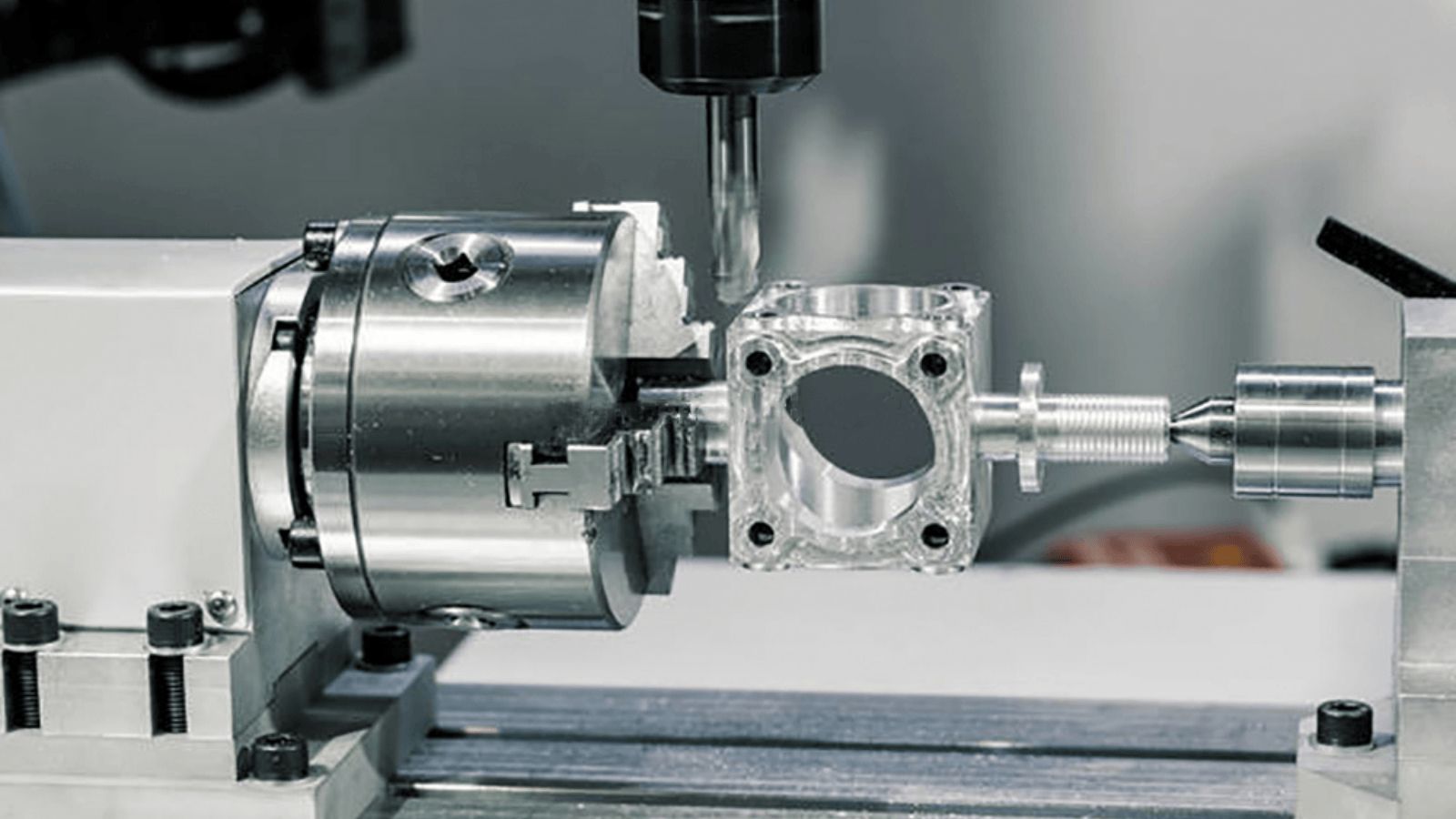
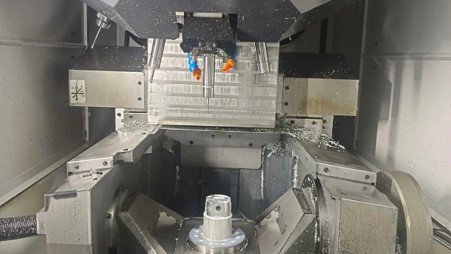
Start with the 3-axis mill you probably know from everyday milling work. Picture a cutter that can only travel along three straight lines: left to right, front to back, up and down. Anything on the side of the part is out of reach. So the operator stops the machine, undoes the clamps, turns the part over, clamps it again and has to hunt for the zero point from scratch. A five axis machine adds two tilting or turning movements, on the table or on the head. The part stays put in the vise and the cutter goes around it instead. I like that, mostly because every time a person handles a part, something small can go wrong.
3+2 Versus Simultaneous
You’ll hear two terms, and the price gap between them is real. In 3+2, the machine tilts the part, locks it at that angle and cuts as if it were 3-axis. Tilt again, cut again. Tools stay short and stiff, which is nice. Simultaneous is the fancy one. All five axes keep moving while the cutter is still biting, a bit like a hand following a curve without ever lifting off. Turbine blades and impellers need that. A box with angled holes doesn’t. Most parts that cross my desk are happy with 3+2, so I’d only ask for simultaneous if the shape really demands it.
Where It Pays Off
Picture a housing with features on five faces. On a 3-axis mill you’re looking at five setups. Each one adds a bit of error, usually a few hundredths of a millimetre, and each one eats clamping time. Run it on a 5-axis machine and it’s often a single setup, so every feature is measured from the same zero. That’s why CNC de precisão shops love it for parts like this. ±0.01 mm is routine, and ±0.005 mm is realistic on the features that matter, mainly because nobody touched the part in between.
Deep pockets are the other big one. A long skinny cutter bends and chatters. Tilt the part and a short cutter gets there instead, so the wall comes out clean. Undercuts and angled holes follow the same logic. Surface finish improves too, since the tool can sit at a nice angle to a curve and leave softer marks.
Parts That Usually Need It
Medical implants almost always do, with all those smooth curves. So do turbine and compressor blades, robot joints with angled mounting faces, and mold inserts with deep shaped cavities. Aerospace brackets cut from a solid block with holes at odd angles end up here as well. If your part looks like one of these, the shop will probably suggest 5-axis before you ask. If it looks like a box with a few holes, they’ll say 3-axis, and you should believe them.
When It’s Just Extra Cost
A flat bracket with holes on one face is a 3-axis job, full stop. Put it on a 5-axis machine and you pay a higher hourly rate for exactly the same cuts. Those rates sit roughly between $75 and $250 an hour depending on the machine and the part, and the programming takes longer as well. 5-axis only saves money when it removes setups or when the part can’t be made any other way. Got a part that needs two setups on a 3-axis mill? Do the sum before you decide. Two cheap setups can beat one expensive hour.
Design Habits That Help
Leave the shop something to hold. The part has to sit in a vise or fixture, and the cutter can’t cut where the jaws are. A small tab you machine off at the end works well, or just a spare flat area. Round your inside corners, because cutters are round and a sharp inside corner means a second, slower process, which costs more.
Keep small features at 0.5 mm or bigger. Anything thinner chatters or snaps. Stick to standard threads too, since M2 to M24 covers nearly everything. And mark the tolerances that matter. Putting a tight tolerance on every dimension is the quickest way I know to turn a fair quote into a scary one.
Material and Finish
Aluminum 6061 and 7075 cut quickly, so 5-axis cycle times stay short. Titanium and stainless are harder on the tools, and what helps there is a smooth toolpath that keeps the cutter loaded evenly. Plastics like PEEK and POM machine well, but they shift a little if you clamp them hard.
As-machined parts usually land around Ra 3.2 µm. On curved faces, 5-axis can often get closer to Ra 1.6 µm. Think about the finish early too. Anodize adds a thin layer, so tell the shop which bores need to stay on size.
Getting the Right Quote
Not sure which way to go? Ask for two quotes, one for 3-axis with the extra setups and one for 5-axis. The difference usually settles it. Send a STEP file, flag the critical tolerances and say how many you need, since setup cost spreads out as the batch grows. A decent shop will also do a DFM check and tell you if one small change moves the part onto a cheaper machine. For a couple of prototypes, setups drive the price. For hundreds, cycle time takes over, and that flips the answer more often than people think.
Conclusão
So, do you need it? If the part has features on several faces, deep pockets, angled holes or curves, probably yes. If it’s mostly flat, probably not. Either way, pick the machine that needs the fewest setups for the shape you drew, and show the shop your drawing early. A good Precision CNC partner will tell you straight when 3-axis does the job.