 Korean
  English
  German
  Russian
  Japanese
  Spanish
  French
  Italian
  Portuguese
 간단한 답변:
Steel turning and 정밀 가공 use CNC lathes to remove material from cylindrical workpieces, holding tolerances typically between ±0.01 mm and ±0.05 mm depending on the part. The process handles bar stock, round billets, and forged preforms in grades from 4140 alloy steel to 303 stainless. It suits high-volume runs of shafts, flanges, bushings, and connector housings. The biggest risk is pairing the wrong steel grade with an inadequate post-machining heat treatment, which cuts fatigue life sharply. Final cost is driven by diameter, batch size, finish specification, and inspection depth.
대부분의 구매자는 주문할 때 custom steel turning parts hit the same gap: they know the part geometry but not which grade, machining sequence, or heat-treatment step will keep it functional under load. YPMFG works with engineers and procurement teams to close that gap before a quote is requested, so the first production run matches spec the first time.
What Steel Turning Actually Involves
CNC turning rotates the workpiece while a single-point or multi-point tool cuts material in a controlled path. A modern 15-axis CNC 선반 can turn, bore, drill, thread, and mill in one setup, which reduces fixturing error and tightens part-to-part repeatability.
The critical constraint is geometry. Turning produces parts whose dominant axis is rotational. If your part has complex freeform surfaces or multiple non-parallel bores, a 5-axis milling operation or a combined turn-mill machine is usually the better path. Selecting the wrong base process adds hours of secondary operations and pushes the unit cost up quickly.
Chucking method, cutting speed, and tool path all influence the achievable 표면 마감 and dimensional stability. A part that looks fine in the fixture can shift once released from the three-jaw chuck if the runout was not controlled during setup.
주문 전 확인해야 할 사양
Before releasing a drawing to a shop, lock down the six parameters below. Missing any one of them forces the machinist to make a judgment call, and that call can quietly change material cost or lead time.
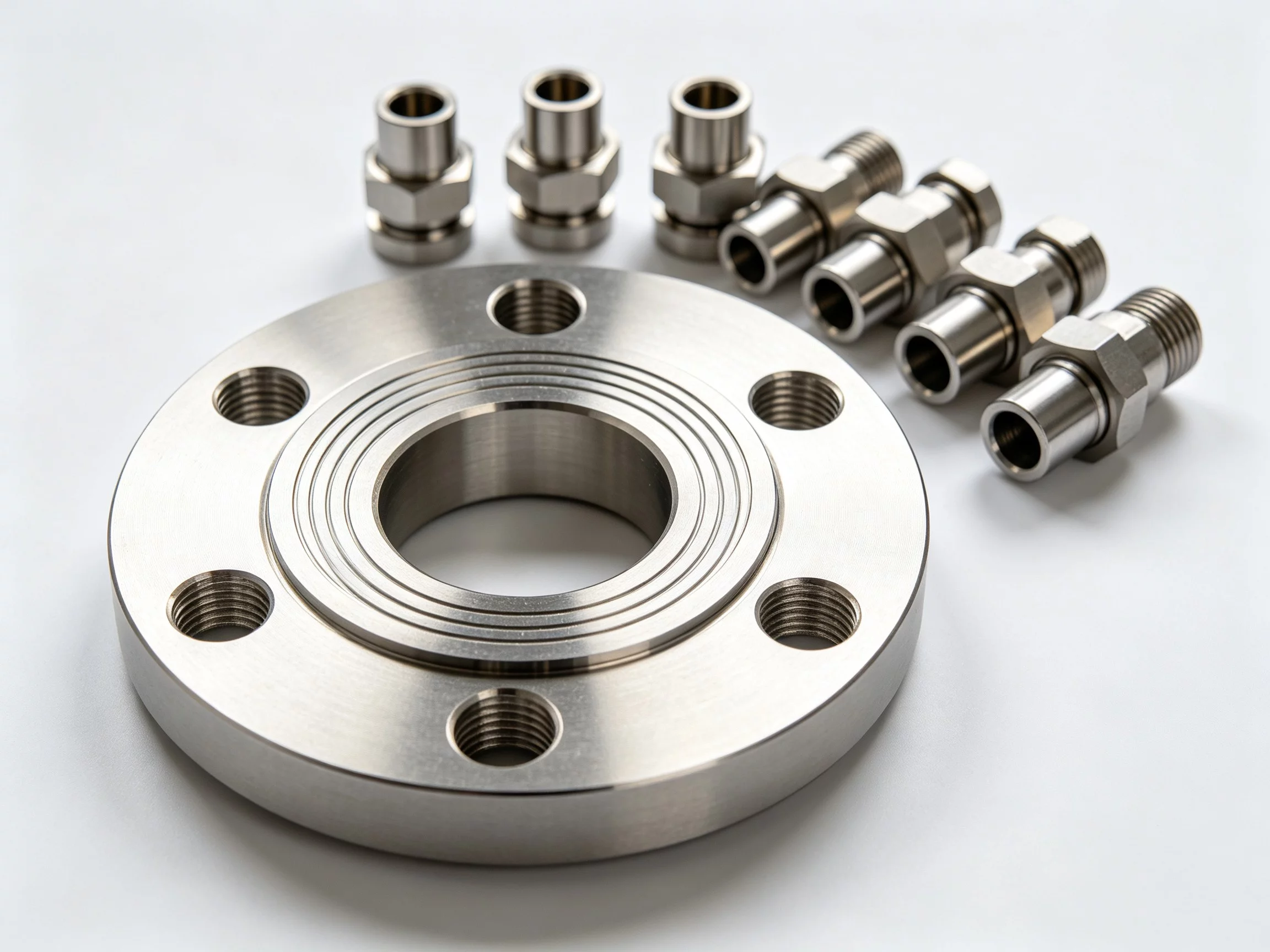
YPMFG reviews all six lines against your drawing before quoting. If a dimension sits outside what the chosen steel can reliably hold after tempering, the team flags it at the engineering stage rather than after the first article fails.
비용 요인과 잠재적 위험
Unit price on a turned steel part is rarely just “metal plus machine hours.” The factors that shift the final number most often:
배치 크기. A 500-piece run amortizes setup and first-article inspection across more parts; a 50-piece run does not.
Diameter-to-length ratio. Long, slender shafts need live-tool support and slower feeds, which stretches cycle time.
Thread and knurl depth. Deep internal threads in hardened steel require broaching or specialized tooling that adds tooling cost.
Finish spec below 0.8 µm Ra. Achieving this on turned steel often demands an extra grinding pass, nearly doubling machine time.
Heat-treatment distortion allowance. If the drawing does not budget for post-hardening movement, the shop must machine an extra allowance, then re-check, adding a full operation.
A common hidden risk: specifying “4140 steel, quenched and tempered” without stating the target hardness range. The shop may pick a temper that is too soft, and the part passes dimensional checks but fails under fatigue in service. Always list the HRC window on the drawing.

How to Choose the Right Process
The decision comes down to part geometry, volume, and the critical tolerance.
For rotationally symmetric parts in volumes above roughly 200 units, CNC 선반 가공 is almost always the fastest and cheapest per-part route. Add a live tool for cross-holes and the part can ship from the lathe in one setup.
For parts with multiple non-parallel features, low volume, or very tight flatness requirements,a 3- or 5-axis CNC 밀링 cell is the better fit. For small batches with extreme bore concentricity, combine turning for the outer profile with precision grinding for the inner bore.
The wrong process choice is the single largest cost lever. A part that could be turned in 12 minutes gets milled in 45 minutes if the shop lacks a proper lathe, tripling the machine cost with no benefit to the part.
구매자들이 자주 묻는 질문
Can 304 stainless be turned to the same tolerance as 4140 alloy steel?
Yes, but 304 is softer and work-hardens, so cutting feeds must be lower. Tolerance capability is the same; cycle time is typically 15-25 % longer.
What diameter range is practical for CNC turning?
대부분 CNC 선반 handle stock from 3 mm up to 250 mm. Beyond that, a larger-capacity machine or a multi-station line takes over.
Do I need material test reports for every batch?
For automotive, medical, or safety-critical applications, yes. Request an En 10204 3.2 certificate with batch-specific tensile and hardness data. For general industrial use, a 3.1 declaration usually suffices.
How does batch size affect unit price?
Unit cost drops steeply from 10 to 100 pieces, levels off around 500, then improves gradually toward 5 000. The steepest savings come from amortizing setup, programming, and first-article inspection.
When should I specify grinding instead of relying on turning alone?
When outside or inside diameter tolerance is below ±0.005 mm or when surface finish must stay under 0.4 µm Ra. Turning alone rarely holds both simultaneously on hardened steel.
더 나은 장기적 결정을 내리기
The cheapest first-article sample rarely tells you how a part will behave after 5 000 cycles or after a temper correction on the next heat. The longer-term move is to lock the steel grade, hardness window, finish spec, and inspection depth in writing before the first order, then hold the process parameters constant batch to batch.
If you have a drawing or a set of 기술 사양 you want second-eyes on, send them to YPMFG. The engineering team will review grade selection, tolerance stack-up, and post-machining sequence, then return a documented assessment with a firm quote. No commitment required; you simply get a clearer picture of what the part will actually cost and how to keep it reliable over its service life.