Portuguese
 English
 German
 Russian
 Japanese
 Korean
 Spanish
 French
 Italian

Laser cutting small holes in sheet metal works down to roughly 0.5 mm in thin stock (0.5–1 mm). Below that, or in thicker plate, dross and heat distortion make drilling or EDM a cleaner route.
You need a pattern of small holes—filters, heat exchangers, perforated panels—and you need them within tolerance without burr or distortion. The real question is whether a laser is the right tool at your hole size and material thickness, and what to verify before releasing a drawing. YPMFG handles this as part of its Usinagem CNC and sheet metal cutting service, so the process choice is made with your spec in hand, not guessed.
- Minimum practical hole size: Roughly 0.5 mm in 1 mm or thinner sheet; dross risk climbs fast in thicker material.
- Hole-to-thickness ratio: A ratio below about 1:1 makes a clean laser cut unreliable on most machines.
- Verification step: Always request a cut-test coupon in your exact alloy and thickness before releasing production.
How Do Fiber and CO2 Lasers Compare for Small Holes?
If your hole sits under 1 mm and your sheet is over 2 mm, plan on a secondary operation—drilling or EDM—after the laser pass. YPMFG can map that combined route when you send your drawing.
What Is the Smallest Hole a Laser Can Actually Cut?
The practical floor is around 0.5 mm in stock no thicker than 1 mm. Below that the kerf width approaches the hole diameter, and the cut becomes an etch rather than a clean through-hole. In 2 mm 304 stainless, 0.5 mm holes start producing visible dross on the exit side.
Why Kerf Width Sets the Floor
A typical fiber-laser kerf is 0.1 to 0.2 mm. When your hole is 0.5 mm and the kerf is 0.15 mm, you lose 30 percent of the intended diameter to vaporized material. In 0.5–0.8 mm sheet the ratio improves, which is why that thickness range handles the smallest holes most cleanly.
Check your kerf compensation file before releasing any drawing that calls for holes under 1 mm. If the supplier cannot show you the compensation value they will apply, ask before you commit.
Which Material and Thickness Combination Matters Most?
Sheet metal thickness and alloy determine whether the cut stays clean. 6061 aluminum at 1 mm handles small holes well because it conducts heat evenly. 316 stainless at the same thickness needs higher assist-gas pressure to keep dross off the exit face. Mild steel sits in between.
Reflectivity and Assist-Gas Choice
Aluminum below 1 mm reflects a meaningful share of the beam, which can damage the lens on machines not rated for it. 304 and 316 are optically safer but oxidize during cutting, leaving a brown discoloration on the exit side. YPMFG specifies the right assist gas—nitrogen for aluminum, oxygen for mild steel, compressed air for stainless—based on your material callout.
Confirm your material spec on the drawing: alloy grade, temper, and exact thickness tolerance. A 0.1 mm thickness variation changes the dross outcome on a 1 mm hole.
How Do You Keep Small-Hole Quality Without Distortion?
Dross forms when the exit side cannot clear the molten material. The fix is faster travel speed, higher assist-gas pressure, and a shorter focal length. Distortion appears when many holes sit close together and heat builds up in the sheet.
- Pulse-cut strategy: Cut each hole individually with a jump between them, not a continuous path, so the sheet cools between pulses.
- Hole spacing: Below 1.5 mm center-to-center on thin gauge, visible warp becomes likely.
- Test coupon: A coupon in your exact gauge and alloy is the only reliable pre-production check.
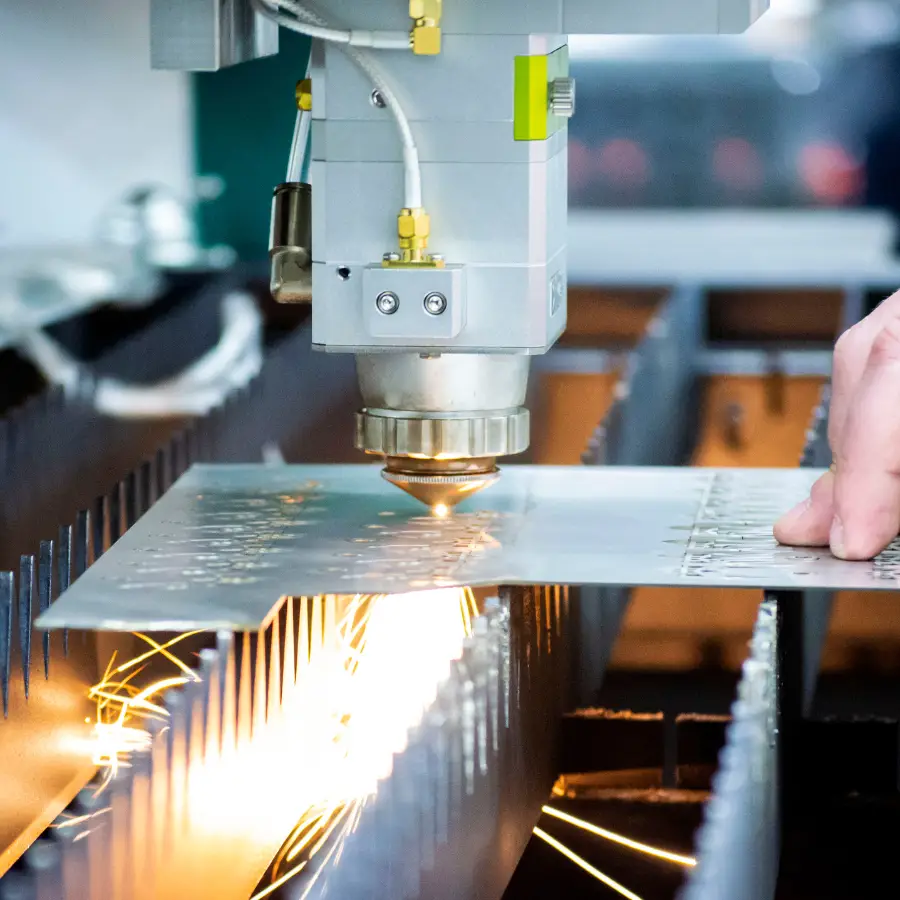
YPMFG runs a cut-test before production and photographs the exit side for your file. If the coupon shows dross, the parameters are adjusted before the full run.
When Should You Switch from Laser to Drilling or EDM?
No. A laser is not the right tool when the hole is under 0.3 mm or when the sheet is over 6 mm and the hole is small relative to thickness. In those cases, EDM drilling or a mechanical drill gives a cleaner,more predictable edge.
The cost crossover depends on volume. For a few hundred holes, drilling is cheaper because there is no setup programming. For thousands of small holes in a complex pattern, laser wins because there is no tool wear. EDM handles hardened steels and titanium where neither laser nor drill works well. If your part mixes a large pattern of 0.8 mm holes with a few 0.3 mm pilot holes, a combined laser-plus-EDM route is the most practical option.
Send your hole-size distribution and total count; a process engineer can map the fastest and cheapest route.
How a Typical Small-Hole Part Moves Through a Laser Shop
Consider a perforated 304 stainless filter plate, 2 mm thick, with a 5 × 5 mm grid of 1.2 mm holes. Step one: DFM review flags the 1.2 mm hole at the 2 mm edge as a dross risk; the pattern is offset 0.5 mm from the edge. Step two: a cut-test coupon runs at two travel speeds; the faster pass clears dross. Step three: production run with nitrogen assist at 3-bar exit pressure. Step four: FAI inspection on the first piece, sampling every 25th piece through the run. Exit-side photos are archived with the lot number.
Process Route Reference: YPMFG process library, reviewed against published tooling data. Client-specific data withheld per NDA.
Practical Questions Before Ordering Small-Hole Laser Parts
Can a Laser Cut a 0.2 mm Hole in 1 mm Steel?
No. The kerf alone is wider than the hole. Use EDM or a mechanical micro-drill for anything under 0.3 mm in steel.
Does Material Type Change the Minimum Hole Size?
It does. 6061 aluminum reflects beam energy, raising the effective minimum. 316 stainless absorbs more, so the minimum stays closer to the machine’s optical limit.
How Do I Know If My Drawing Is Laser-Feasible?
Send the material, thickness, hole diameter, and hole count to a Usinagem CNC shop for a 30-minute feasibility review. If the hole-to-thickness ratio is above 1:1, laser is almost always viable.
What Tolerance Can I Expect on a 1 mm Hole?
Typically within a few hundredths of a millimeter, depending on material and machine. For anything tighter, ask the supplier to quote the tolerância de usinagem CNC they can hold on that specific diameter.
Getting the Right Small-Hole Part Without Guesswork
Matching hole size, material, and thickness to the right process saves you a rejected batch and a costly re-cut. Before you commit, send your drawing or specification to YPMFG. An engineer will flag any dross or distortion risk, recommend a test coupon, and confirm the tolerance your part actually needs. You receive a written process recommendation with the specific parameters to check, not a generic quote. No obligation, no minimum order—just a clear answer on whether your small-hole pattern will come out clean.