Korean
 English
 German
 Russian
 Japanese
 Spanish
 French
 Italian
 Portuguese

A precision CNC machining part fits your application when its tolerance class, material grade, and surface finish are validated against assembly requirements—not just the nominal drawing. The three most frequent failure points are unmet tolerance stack-up, material selection that does not match the operating environment, and skipped 표면 마감 callouts. Confirm whether your part must meet an ISO 2768 class or a tighter custom spec before releasing the job. YPMFG can review your drawings and flag specification gaps before production starts.
Most buyers specify a part on paper, then discover during assembly that clearances are tight or the material fatigues faster than planned. The root cause is rarely the CNC machine. It is the gap between what the drawing says and what the part actually needs to do in service.
## Tolerances and Specs to Verify Before Placing an Order
The first decision is always the tolerance class. A CNC 가공 부품 holding ±0.001 in behaves very differently from one at ±0.010 in in both cost and cycle time. Before you send a drawing to a shop, confirm which features are truly critical and which can relax to a general class.
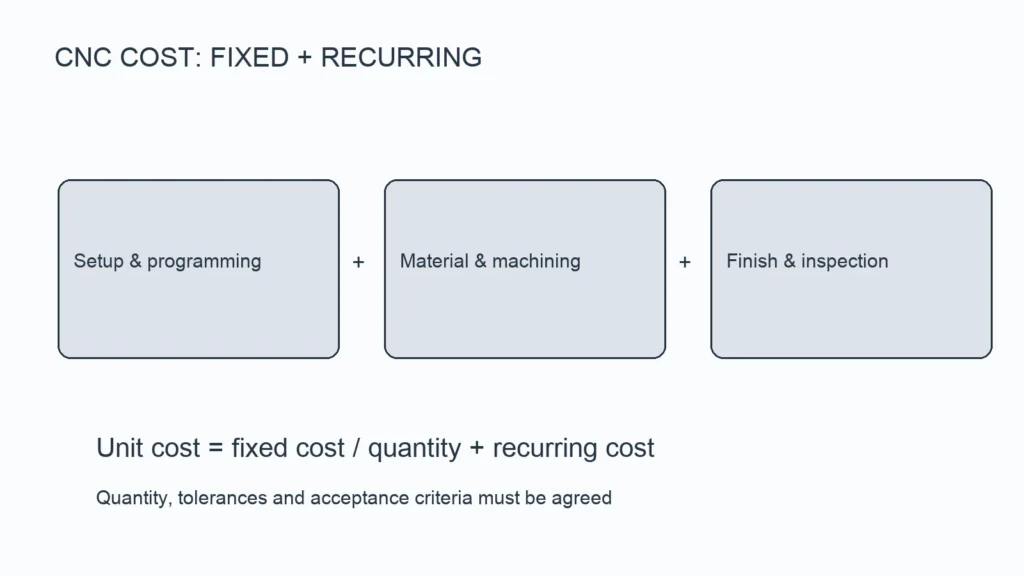
The takeaway is simple: do not apply the tightest tolerance to every feature. Over-specifying drives up CNC 가공 비용 without adding functional value. If you are unsure which features carry the load, send your assembly drawing to YPMFG for an engineering review. They will mark the features that genuinely need tighter control and recommend where a general class will do.

Material and Finish: Where Specifications Go Wrong
Material choice affects fatigue life, corrosion resistance, and how the part performs in its real operating environment. A 6061-T6 알루미늄 CNC 가공 부품 will not last as long as a 17-4 PH stainless version in a salt-air application, even if the geometry is identical. Match the alloy grade to the expected service life, not just to the cheapest option on the quote.
Surface finish matters just as much. A bead-blasted or anodized finish changes the coefficient of friction, the fatigue initiation sites, and the corrosion window. Specify the finish on the drawing, not in a verbal phone call. Unfinished raw stock can look acceptable in the bin but fail within weeks once it meets moisture or a mating polymer.
If your part operates in a regulated environment, confirm the required 자재 인증 documents—mill certificates, heat-treatment records, and first-article inspections—before you commit to a supplier. Skipping these steps means you may spend months troubleshooting a failure that a 20-minute document review would have caught.
Three Mistakes That Add Unnecessary Cycles
Specifying a custom alloy without checking availability. Some aerospace-grade alloys carry multi-week lead times. Confirm stock before you lock the design.
Leaving critical datums undefined. Without clear GD&T datums, each operator interprets the part slightly differently. Batch-to-batch variation creeps in.

Ordering a single prototype without a production plan. A part that works as a one-off may not hold up at 5,000 units. CNC part design for manufacturability should happen before the first cut.
Each of these mistakes adds rework loops, secondary operations, or scrap. Budgeting time for a design-for-manufacturability review before the first CNC cycle saves more than the review itself.
Questions Buyers Ask Before Committing
Can a CNC shop machine both exterior and interior features in one setup?
In many cases, yes, if the part geometry allows tool access. For deep bores or blind features, a 5축 CNC 가공 setup may be needed to hold all tolerances in one coordinate system. Ask the shop to confirm the setup before approving the drawing.
How do I know if my tolerance spec is realistic?
Compare your critical features against the shop’s standard CNC machining capabilities. A ±0.0005 in bore is achievable on modern equipment but will cost significantly more than ±0.002 in. If the application tolerates the looser value, use it.
What documentation should I request with a first article?
Minimum set: dimensional report, material mill certificate, heat-treatment log if applicable, and surface-finish verification. For medical CNC machining or aerospace work, add PPAP or FAI Form 21 series. Confirm the list with your internal quality gate before signing off.
Is it cheaper to buy a standard off-the-shelf part or machine a custom one?
Not always. A standard part may force design compromises that add fasteners, adapters, or secondary processing. Run a total-ownership-cost comparison that includes assembly labor,failure probability, and replacement frequency before defaulting to either option.
더 나은 장기적 결정을 내리기
The value of a well-specified precision CNC machining part is not just the first unit on the bench. It is the 5,000th unit that still meets tolerance, the material that has not corroded after two years, and the absence of a recall. If you are comparing options or reviewing a drawing before your next production run, send your specifications to YPMFG. Their engineers will return a marked-up review, material and finish recommendations, and a clear scope before any cutting begins.