French
 English
 German
 Russian
 Japanese
 Korean
 Spanish
 Italian
 Portuguese

TL;DR: Grooving cuts a shallow channel into a workpiece; parting off severs a finished part from the bar stock. If the cut goes fully through the diameter, that is a parting-off operation. If it stops short, it is a groove. The tool width and machine load requirements diverge sharply between the two.
Buyers frequently label a through-cut as a “groove” on the drawing, then wonder why the first-article inspection failed. The confusion adds setup time, risks a broken tool mid-batch, and can push a part out of Tolérance d'usinage CNC specs. YPMFG engineers see this mismatch in incoming RFQs more than any other labeling error. The two operations look nearly identical on a 2D section view but demand different tool clearance, depth limits, and machine rigidity. Getting the label right up front saves a rework cycle.
Key Takeaways for Specifying the Operation
- Cutting depth ratio: Grooving tools typically run at 60 to 80 percent of their width; parting off must clear the full part diameter with zero contact on the finished surface.
- Blade thickness: A parting-off blade is thinner, often 1.5 to 3.2 mm, so it passes through an internal bore without snagging on the opposite wall.
- Overhang vibration: Parting off concentrates cutting force on a narrow edge; overhangs beyond 3 times blade width raise deflection and surface-roughness risk.
- DFM threshold: Any groove deeper than 50 percent of tool width shifts the operation into parting-off territory and may require a secondary milling pass.
Grooving vs Parting Off at a Glance

If your drawing calls for a full through-cut on a rotating part, that is parting off regardless of the label the drafter placed in the note block.
What Is the Physical Difference Between Grooving and Parting Off?
The core difference is whether the tool exits the workpiece or not. A groove terminates inside the part; a parting-off blade exits completely and the finished piece drops free. This changes the force path through the tool shank and the spindle nose. In a groove, both flanks remain engaged in metal for the full depth. In a part-off, the last millimeter of cut happens with the blade fully exposed to air, where thermal and mechanical deflection spike.
For a typical 25 mm diameter shaft, a 4 mm groove cut leaves 21 mm of uncut material acting as a support. A 2 mm parting-off blade leaves only a 23 mm bridge that must flex under its own weight plus cutting force. The flexure governs the final Tolérance d'usinage CNC on the parting surface. One physical limit to acknowledge: neither operation can produce a clean 90-degree internal corner without a secondary EDM wire cut or reaming pass; the tool nose radius always leaves a small fillet.
Next step: check whether your drawing specifies a through-cut or a blind channel. If the section line shows the tool exiting the part, mark it as parting off and flag the blade width to the supplier.
How Do Tool Geometry and Machine Load Differ?
Tool geometry drives the machine load in two ways: rake angle and side clearance. Grooving inserts use a wider flank angle (typically 0 to 5 degrees of side clearance per side) because they do not need to clear an internal bore. Parting-off blades carry 4 to 8 degrees of clearance on each flank so the finished part can slide off without rubbing. YPMFG process engineers specify this clearance on the traveler sheet before the first setup.
Machine load shifts from radial to axial as the blade thins. A 12 mm groove tool loads the spindle radially; a 1.6 mm blade loads it axially and through the headstock. The practical effect: parting-off operations on longer overhangs often require a tailstock support or a steady rest to keep the finished part from whipping. If the overhang exceeds roughly 3 times blade width, surface finish degrades and the blade life drops. That is a hard limit of the tool, not a machine setting. You cannot solve a 10 mm overhang on a 2 mm blade by simply slowing the feed.
Before releasing a part for production, verify the blade width against the internal bore diameter. A 1.6 mm blade on a 3 mm bore leaves under 0.7 mm of clearance on each side; any runout will contact the opposite wall and snap the tool.
Which Operation Should Your Drawing Actually Specify?
The answer depends on whether the cut is functional or separative. A relief groove for an O-ring, a thread run-out groove, or a step for a bearing seat is a grooving operation. A cut whose sole purpose is to detach a finished piece from the remaining bar is parting off. Mixing the two labels on one drawing confuses the programmer and the setup technician, because the tool list and the operation sequence differ.
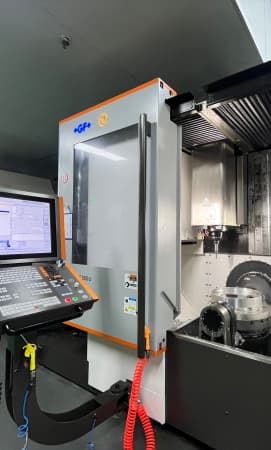
In practice, many multi-feature shafts use both: a series of shallow grooves near the head, then a final parting-off cut at the tail. The programming sequence matters. Grooves are cut first at full depth, then the parting-off pass runs last so the finished grooves are not re-cut or marred. If your supplier quotes one combined operation, ask for the individual cycle times. A 12 mm groove on a 40 mm shaft and a 2 mm part-off are not the same workload,and lumping them hides where the bottleneck actually sits.
Send your drawing to YPMFG for an engineering review if the operation is ambiguous; the team will flag which features are grooves and which are parting-offs, and confirm the tool list before quoting.
How a Groove-to-Part-Off Route Handles a Typical Stepped Shaft: A Process Walkthrough
A stepped shaft with three diameter changes and two O-ring grooves is the most common part that triggers this question. The route looks like this:
- Op 10 – Face and OD roughing: Face the blank, rough to within 0.4 mm of final on all three diameters. Control point: runout under 0.05 mm at the tail support.
- Op 20 – Groove milling: Cut the two O-ring grooves with a 4 mm wide grooving insert. Feed roughly 0.08 mm per rev at a spindle speed matched to the material (for aluminium 6061, expect the higher end of the speed range). Control point: groove width within ±0.05 mm, depth within ±0.03 mm.
- Op 30 – OD finishing: Finish-cut all three diameters to final Tolérance d'usinage CNC, typically ±0.02 mm on the bearing seats. Control point: surface finish Ra under 1.6 µm on the sliding surfaces.
- Op 40 – Parting off: Run the 2 mm blade through at low feed (0.03 to 0.05 mm per rev). Control point: burr-free exit, no witness marks on the adjacent finished face.
- Op 50 – Deburr and inspect: Deburr the parting edge, then run first-article inspection to the ASME Y14.5 drawing. Report travels with the batch.
Process Route Reference: YPMFG process library, reviewed against published tooling data. Client-specific parameters withheld per NDA.
The one thing this route cannot do: it cannot produce a groove deeper than the tool width without a secondary Fraisage CNC pass. If your O-ring groove depth exceeds the available insert width, the drawing needs a note authorizing a mill operation.
Practical Questions Before Specifying the Operation
Can I just use a grooving tool for a parting-off cut? No. A grooving tool is too wide to clear an internal bore or a tight step. Forcing a 6 mm groove tool through a 3 mm bore will bind and break the insert. Use a blade matched to the clearance you actually have.
Does the material change which operation I need? It changes the tool, not the classification. A groove is still a groove and a part-off is still a part-off whether the stock is 316L stainless or aluminum. The difference shows up in cutting speed, feed, and blade thickness required. Stainless demands a thicker blade to avoid chipping the narrow cutting edge.
What is the thinnest part I can safely part off on a standard lathe? It cannot be guaranteed below roughly 0.5 mm wall thickness without a custom fixture or a secondary saw operation. Thin-wall parting on a standard chuck invites chatter and dimensional scatter. For walls under 0.8 mm, a step-off or a band-saw cut is the safer route.
How do I quickly tell if my drawing is ambiguous? Look at the section line. If the tool symbol exits the part contour, it is parting off. If it stops inside, it is a groove. If the drawing shows both on the same station, ask the supplier to confirm the operation sequence so the grooves are not re-cut after the final pass.
Choosing the Right Operation for Your Next Part
The right label on the drawing is the cheapest quality control you will ever run. A correctly identified groove versus parting-off cut means the programmer picks the right tool, the operator loads the right clearance, and the inspector checks the right surface. None of that takes extra cost; it just takes one correct word on the note block.
YPMFG reviews every incoming drawing against this classification before quoting. You can send your specifications and a cross-section view, and the engineering team will return a marked-up copy showing which features are grooves, which are part-offs, and where a secondary operation may be required. The review also flags any Tolérance d'usinage CNC call that a standard lathe pass cannot hold, so you hear about it at the quote stage, not at first article. If the operation is straightforward, you get a firm lead time within the 3-day sampling window. If it needs a fixture or a combined route, you get a short process sheet explaining the sequence before any steel moves. Send the drawing over and let the classification settle before the next revision cycle starts.